
Houston County Court Records After Arrest
After a Houston County arrest, the first public trail is often the jail booking. That record may list an arrest date, held-for agency, warrant text, charge description, and bond wording. The court record begins when the charge reaches the proper court or prosecutor channel. Felony matters generally move through Superior Court, while State Court handles misdemeanor violations, traffic matters, game and fish cases, and county ordinance charges. The Houston Judicial Circuit District Attorney, led by Eric Z. Edwards, represents the State of Georgia in criminal matters pending in Houston County Superior Court and Juvenile Court.
The jail side and court side answer different questions. The Houston County jail inmate records page is the better place to confirm custody, booking status, and roster hold text. The Houston County jail mugshots page covers booking photos and Georgia booking-photo restrictions. Court records after a jail arrest are for the filed case: the charge list, case number, hearing path, bond orders, prosecutor action, final disposition, and copy requests through the clerk.
The Houston County District Attorney page is useful because jail charges can change once the prosecutor reviews the facts. A booking charge can be reduced, amended, added to, dismissed, or replaced by a filed accusation or indictment. That is why the court case should be checked before treating a roster charge as the final court record.
Find Houston County Court Records
Houston County uses Benchmark for court search and efiling. The Benchmark case search portal is the online channel for filed case information, while the Superior Court Clerk page says public terminals are available at the clerk's office for public access. The county reported that it transitioned to Benchmark efiling and regular case search effective April 1, 2025. Some access features may depend on registration, but the public search route is the starting point for court records after a jail arrest.
- Open the official Benchmark case-search portal and begin with the defendant's name if no case number is known.
- Search the case number when it appears in court paperwork, warrant text, or clerk communication.
- Check the court tied to the charge. Superior Court handles felony-level records, and State Court handles many misdemeanor and traffic records.
- Read the charge list and current status instead of relying only on the arrest wording from the jail roster.
- Use the clerk's public terminal or copy process when an online search does not show the needed document.
The Superior Court Clerk page gives the public-terminal fallback and copy fees. Copies are listed at $0.50 per page, certified copies at $2.50, and exemplified copies at $2.50. The State Court page and misdemeanor clerk material identify the State Court criminal and traffic role, including final disposition reporting to GCIC.
The official Benchmark search page shows the court case-search entry point used for Houston County case lookup.
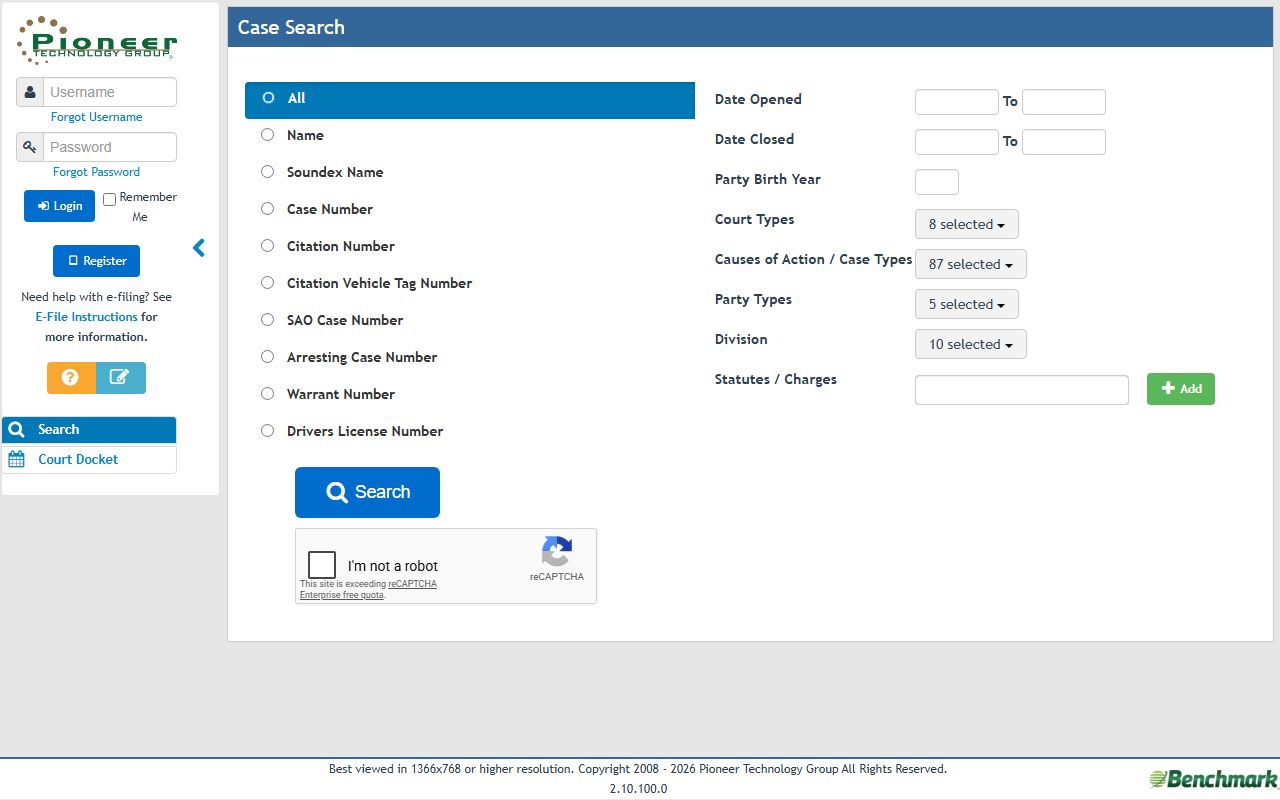
Use the case-search result with the jail roster and clerk record, because the court record may lag behind a fresh arrest until charges are filed.
Houston County Case Search Fields
The Benchmark public search controls may vary by session, court selection, and registration status. The research capture confirmed a case-search form for Houston County courts and the county pages link the portal for Superior, State, and Magistrate case resources. Search broad first, then narrow when the result list is too large. A name search is useful right after arrest, while a case number search is more precise once the court file is open.
| Field | Type | Required | Use |
|---|---|---|---|
| Name or party search | Text | Unspecified | Use the defendant name after charges are filed. |
| Case number | Text | Unspecified | Use the formal court case number when known. |
| Court selection | Dropdown or linked court route | Unspecified | Match the case to Superior, State, or Magistrate records. |
| Search type controls | Web form controls | Unspecified | Controls may differ by court and login state. |
Charges Filed After Arrest
A Houston County jail arrest does not always show the final charge wording. The jail roster may show the arrest or hold reason, including warrant numbers, Georgia offense codes, bond text, and judge-setting notes. The court record is built from filed charging documents and later entries by the clerk. Those records show whether the case is a misdemeanor, felony, traffic matter, ordinance case, or another criminal filing routed through the right court.
| Document | Who Uses It | What It Does |
|---|---|---|
| Complaint | Officer, court, or prosecutor channel | Starts or supports a charge at the early case stage. |
| Accusation or information | Prosecutor | States the charge the State chooses to file without a grand-jury indictment. |
| Indictment | Grand jury and prosecutor | Used in serious felony matters after grand-jury action. |
The District Attorney page should be read as a prosecutor contact and role source, not a custody lookup. Custody stays with the sheriff and jail. Filed criminal cases, hearing records, and certified copies route through the clerk and the court system.
Houston County Charge Status
Charge status is one reason court records after a jail arrest matter. A person can be arrested on one charge description, booked under a warrant, and later face a different filed charge. The court record can show whether a count is pending, amended, reduced, dismissed, or resolved by plea, trial, or prosecutor action. Read each count on its own, because one case can have several charges with different outcomes.
| Status | Meaning in the Court Record |
|---|---|
| Pending | The charge is still open and has not reached final disposition. |
| Amended or reduced | The filed charge changed after review, negotiation, or court action. |
| Dismissed | The court record reflects that the charge did not proceed to conviction. |
| Nolle prosequi | The prosecutor chose not to pursue that charge. |
| Disposition | The recorded outcome, such as guilty, not guilty, dismissed, or nolle prosequi. |
Note: Booking charges are arrest-stage records; court charges and dispositions should be checked before drawing conclusions.
Bond After Houston County Arrest
Houston County roster records expose bond information in hold-reason text rather than a separate bond table. Inspected records showed wording such as No Bond, Own Recognizance Bond, and Set By Judge. Bond may apply count by count. A person can also have an additional hold from another court, county, state agency, federal agency, probation, parole, DOC, ICE, or U.S. Marshals channel. In that situation, one bond entry does not prove the person can leave custody.
| Bond Type | How to Read It |
|---|---|
| Cash bond | Money is posted directly with the proper authority, subject to current local rules. |
| Surety bond | A licensed bonding company backs the release bond. |
| Own recognizance | Release is based on a promise to appear, shown in county data as Own Recognizance Bond. |
| No bond | No release bond is currently available for that count or hold. |
| Additional hold | Another agency or court may block release even when one charge has bond. |
When timing matters, the jail at (478) 218-4900 is the custody and bond-status fallback. Benchmark court records can show filed case information after the arrest record reaches court, and the clerk or court should be used when bond was set by a judge.
Warrants After Houston County Arrest
Houston County did not publish a standalone active-warrant search list in the official source set. The Sheriff's Warrants & Records page says the Warrant Division serves outstanding warrants and civil papers issued by Houston County Magistrate, State, and Superior Courts, other Georgia courts, and out-of-state courts. The Warrant Division phone is (478) 542-2095, and the Records Division phone is (478) 542-2130.
The jail roster becomes useful after a warrant turns into a booking. Inspected hold-reason text showed arrest warrant and bench warrant entries, warrant numbers, issuing jurisdiction, offense code, charge description, arrest date, bond status, and judge-setting text. Court records after an arrest should then be checked for the case tied to the warrant or bench-warrant event.
Charges vs Convictions
An arrest charge is an allegation. A conviction is a court outcome. Houston County court records after a jail arrest may include both charged counts and final dispositions, so the difference matters for readers checking a case, employer-controlled background process, bond issue, or record-restriction question. The State Court misdemeanor page says final dispositions are reported to GCIC, but a public case search is still not the same as an official criminal-history product.
| Issue | Charge | Conviction |
|---|---|---|
| Stage | Allegation filed or listed after arrest. | Final court outcome after plea, verdict, or judgment. |
| Where it appears | Jail roster, warrant text, court case entry. | Court disposition and criminal-history channels. |
| Can it change? | Yes, it may be amended, reduced, or dismissed. | Changes usually require later court action or legal relief. |
Restricted Arrest Court Records
Georgia often uses the term record restriction rather than expungement. The Houston County Sheriff's Records Division processes record-restriction applications and lists a $25 fee. The Georgia Open Records Act still permits access to many public records, but exemptions, court orders, juvenile rules, restricted criminal-history records, and ongoing investigations can limit what is released. The Georgia Attorney General open-government FAQ explains response timing, fees, denials, and exemptions for public-record requests.
| Issue | Sealed or Restricted | Expunged |
|---|---|---|
| Georgia wording | Record restriction is the common Georgia route. | Expungement is often used casually but may not be the exact Georgia term. |
| Public visibility | Eligible information may be limited from public criminal-history access. | Do not assume physical destruction unless a law or order says so. |
| Houston County route | Records Division processes record-restriction applications. | Use the court or qualified legal help for case-specific relief. |
Public Access and Copy Rules
Georgia's Open Records Act generally allows public inspection and copying of public records unless an exemption applies. The Houston County clerk and sheriff records channels are different. The clerk handles court-case records and court-copy requests. The Sheriff's Records Division handles incident reports, accident reports, arrest warrants, civil processes, local criminal-history checks, record restriction applications, taxi permits, and public-record request routing.
Important: Do not use casual court or custody lookups for credit, employment, insurance, housing, or other FCRA-regulated screening.
Public Record Search
Sponsored Results